


Ipamorelin vs Sermorelin vs Tesamorelin
Three growth hormone secretagogue peptides that reach the pituitary through two different receptors — one ghrelin-receptor agonist and two GHRH-receptor analogs — compared side by side: structure, receptor pharmacology and what the published literature reports, with sources.
At a glance
| Ipamorelin | Sermorelin | Tesamorelin | |
|---|---|---|---|
| Receptor target | GHS-R1a (ghrelin receptor) | GHRH receptor | GHRH receptor |
| Class | Synthetic GH secretagogue (ghrelin-receptor agonist) | Truncated GHRH analog | Full-length, N-terminally modified GHRH analog |
| Length | 5 residues | 29 amino acids | 44 amino acids |
| Structure | Aib-His-D-2-Nal-D-Phe-Lys-NH₂ | GHRH(1–29)-NH₂ | GHRH(1–44)-NH₂ + trans-3-hexenoyl group on Tyr¹ |
| Molecular formula | C₃₈H₄₉N₉O₅ | C₁₄₉H₂₄₆N₄₄O₄₂S | C₂₂₁H₃₆₆N₇₂O₆₇S |
| Molecular weight | ≈ 711.9 g/mol | ≈ 3357.9 g/mol | ≈ 5135.9 g/mol |
| Supplied form | Lyophilized powder, sealed vial | Lyophilized powder, sealed vial | Lyophilized powder, sealed vial |
Ipamorelin: the ghrelin-receptor agonist
Ipamorelin is a synthetic pentapeptide (Aib-His-D-2-Nal-D-Phe-Lys-NH₂). In its 1998 characterization it was described as the first selective growth hormone secretagogue: in the pituitary-cell and animal models used, it released GH without the ACTH and cortisol increases reported for earlier GH-releasing peptides such as GHRP-6 and GHRP-2.1 Its target is the growth hormone secretagogue receptor type 1a (GHS-R1a), a G-protein-coupled receptor cloned from pituitary and hypothalamus in 1996 as the site of action of synthetic GH secretagogues.2
Sermorelin: the GHRH(1–29) fragment
Sermorelin is the synthetic, C-terminally amidated 1–29 fragment of human growth hormone-releasing hormone, GHRH(1–29)-NH₂ — the shortest sequence described as retaining the activity of the native 44-amino-acid hormone.3 It acts at the GHRH receptor, a G-protein-coupled receptor on pituitary somatotrophs whose activation was characterized as Gs-coupled, stimulating cAMP production through adenylate cyclase.4
Tesamorelin: full-length, stabilized GHRH
Tesamorelin (development code TH9507) keeps all 44 amino acids of human GHRH and adds a trans-3-hexenoyl group to the N-terminal tyrosine. Its non-clinical pharmacology studies described this modification as improving stability against enzymatic cleavage at the N-terminus — the site where native GHRH is inactivated by dipeptidyl aminopeptidase — while preserving activity at the GHRH receptor.5
Key difference for researchers: ipamorelin acts through GHS-R1a, while sermorelin and tesamorelin both act at the GHRH receptor — so the three let a design compare two receptor pathways and, within the GHRH pathway, a truncated fragment against a full-length, N-terminally modified analog.
Choosing between them in a study design
- Receptor pathway: pairing ipamorelin with either GHRH analog contrasts GHS-R1a signaling with GHRH-receptor (Gs/cAMP) signaling at the same endpoint.
- Within the GHRH receptor: sermorelin vs tesamorelin compares the 1–29 fragment with a full-length analog carrying an N-terminal stabilizing group.
- Hormone panels: ipamorelin’s reported selectivity — no ACTH or cortisol increase in its original models1 — matters for assays that also read other pituitary or adrenal hormones.
- Handling: all three are supplied lyophilized and handled the same way — see storage below.
Storage & handling
Store sealed, lyophilized vials dry and protected from light at −20 °C for long-term storage. Once reconstituted, keep refrigerated at 2–8 °C and divide into single-use aliquots. Reconstitution is typically performed with sterile bacteriostatic water. Full guide: peptide storage & handling.
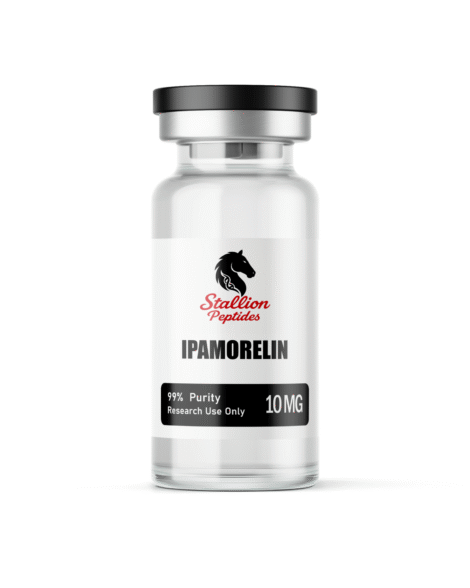
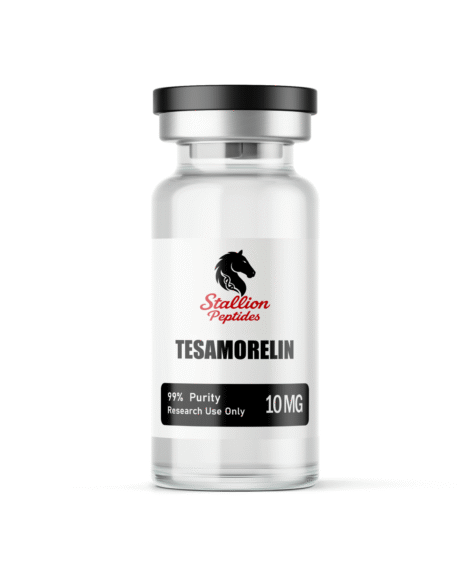
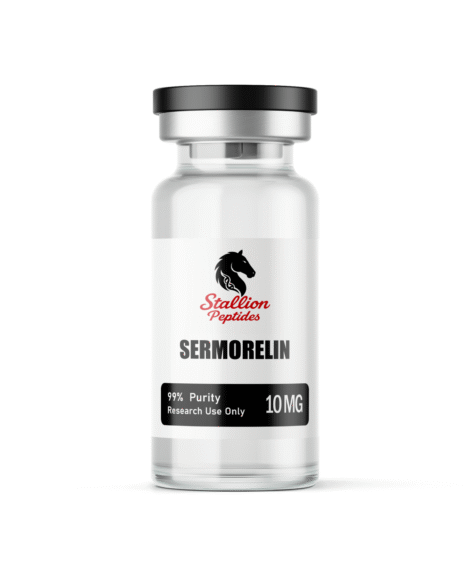
Ipamorelin, Sermorelin & Tesamorelin at Stallion Peptides
Sealed, lyophilized vials. Orders before 3 PM Pacific time ship the same day by USPS to the United States and Puerto Rico — free over $200.
Frequently asked questions
What is the difference between ipamorelin, sermorelin and tesamorelin?
Ipamorelin is a synthetic pentapeptide agonist of the ghrelin receptor (GHS-R1a). Sermorelin and tesamorelin are analogs of growth hormone-releasing hormone that act at the GHRH receptor: sermorelin is the 1–29 fragment, and tesamorelin is the full 44-amino-acid sequence with an N-terminal trans-3-hexenoyl group.
Why was ipamorelin described as a selective GH secretagogue?
In its 1998 characterization, ipamorelin released growth hormone in laboratory models without the ACTH and cortisol increases reported for earlier GH-releasing peptides such as GHRP-6 and GHRP-2.
How do sermorelin and tesamorelin differ structurally?
Sermorelin is GHRH(1–29)-NH₂, a truncated, amidated fragment. Tesamorelin keeps all 44 residues of human GHRH and carries a trans-3-hexenoyl group on the N-terminal tyrosine, a modification described in non-clinical studies as improving stability against enzymatic cleavage.
How should these peptides be stored?
Sealed and lyophilized at −20 °C, dry and away from light; once reconstituted, refrigerated at 2–8 °C in single-use aliquots.
References
- Raun K, Hansen BS, Johansen NL, et al. Ipamorelin, the first selective growth hormone secretagogue. Eur J Endocrinol. 1998;139(5):552–561. PubMed 9849822
- Howard AD, Feighner SD, Cully DF, et al. A receptor in pituitary and hypothalamus that functions in growth hormone release. Science. 1996;273(5277):974–977. PubMed 8688086
- Prakash A, Goa KL. Sermorelin: a review of its use in the diagnosis and treatment of children with idiopathic growth hormone deficiency. BioDrugs. 1999;12(2):139–157. PubMed 18031173
- Gaylinn BD. Growth hormone releasing hormone receptor. Receptors Channels. 2002;8(3–4):155–162. PubMed 12529933
- Ferdinandi ES, Brazeau P, High K, et al. Non-clinical pharmacology and safety evaluation of TH9507, a human growth hormone-releasing factor analogue. Basic Clin Pharmacol Toxicol. 2007;100(1):49–58. PubMed 17214611
This summary collects published laboratory literature as a research reference. Products are sold for laboratory research use only. Not for human or veterinary use.
