What is sermorelin?
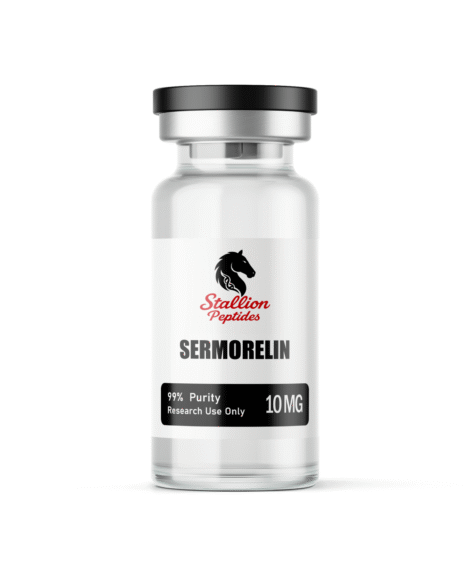
Sermorelin is the synthetic peptide GHRH(1–29)-NH₂: the first 29 amino acids of human growth hormone–releasing hormone, with an amidated C-terminus. Native GHRH has 44 amino acids; it was first sequenced in 1982 from a pancreatic tumour.1 The N-terminal 1–29 region was found to be the shortest fragment that keeps full activity at the GHRH receptor, which made sermorelin a standard tool for GHRH-receptor research.2
GHRH-receptor signalling
The GHRH receptor is a class B G-protein-coupled receptor expressed on pituitary somatotroph cells. Its activation raises intracellular cAMP and drives GH synthesis and release. Because sermorelin is unmodified, it is rapidly cleaved by DPP-4 at its N-terminus — a property that stabilised analogs such as tesamorelin were designed to overcome.
Common research areas
- GHRH-receptor pharmacology — cAMP signalling in pituitary cell models.
- Structure–activity work — which GHRH residues are required for receptor activity.2
- Analog comparisons — unmodified GHRH(1–29) vs stabilised analogs such as tesamorelin.
- Two-receptor designs — GHRH agonists combined with ghrelin-receptor agonists such as ipamorelin.
Chemical & physical data
| Property | Value |
|---|---|
| Sequence | GHRH(1–29)-NH₂ |
| Length | 29 amino acids |
| Molecular formula | C₁₄₉H₂₄₆N₄₄O₄₂S |
| Molecular weight | ≈ 3357.9 g/mol |
| CAS number | 86168-78-7 |
| Supplied form | Lyophilized (freeze-dried) powder, sealed vial |
Storage & handling
Store lyophilized (powder) vials sealed, dry and away from light — at −20 °C for long-term storage. Once reconstituted, keep refrigerated at 2–8 °C. Allow vials to reach room temperature before opening to avoid condensation. Reconstitution is typically performed with sterile bacteriostatic water; see our storage & handling guide.