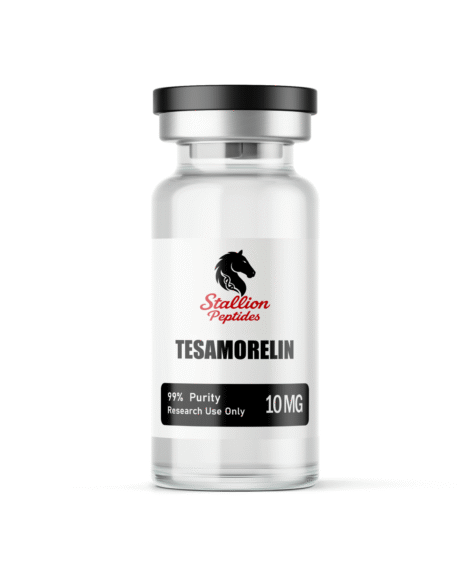
What is tesamorelin?
Tesamorelin (development code TH9507) is a synthetic analog of human growth hormone–releasing hormone. It contains the full 44-amino-acid GHRH sequence — native GHRH was first sequenced in 19821 — with one key addition: a trans-3-hexenoyl group attached to the N-terminal tyrosine.2
Why the N-terminal modification matters
Native GHRH is cleaved quickly by the enzyme DPP-4, which removes the first two N-terminal residues and inactivates the hormone. Acylating the N-terminus with trans-3-hexenoic acid protects this site, giving a peptide that keeps GHRH-receptor activity while resisting rapid breakdown in non-clinical studies.2
Common research areas
- GHRH-receptor pharmacology — a stabilised full-length agonist at pituitary GHRH receptors.2
- Peptide stabilisation — N-terminal acylation vs DPP-4 cleavage.
- Analog comparisons — full-length stabilised GHRH vs the short sermorelin fragment.
- Two-receptor designs — GHRH analogs alongside ghrelin-receptor agonists such as ipamorelin.
Tesamorelin vs sermorelin at a glance: tesamorelin = GHRH(1–44) + N-terminal trans-3-hexenoyl (stabilised); sermorelin = GHRH(1–29)-NH₂ (unmodified).
Chemical & physical data
| Property | Value |
|---|---|
| Structure | GHRH(1–44)-NH₂ + N-terminal trans-3-hexenoyl |
| Length | 44 amino acids |
| Molecular formula | C₂₂₁H₃₆₆N₇₂O₆₇S |
| Molecular weight | ≈ 5135.9 g/mol |
| CAS number | 218949-48-5 |
| Supplied form | Lyophilized (freeze-dried) powder, sealed vial |
Storage & handling
Store lyophilized (powder) vials sealed, dry and away from light — at −20 °C for long-term storage. Once reconstituted, keep refrigerated at 2–8 °C. Allow vials to reach room temperature before opening to avoid condensation. Reconstitution is typically performed with sterile bacteriostatic water; see our storage & handling guide.