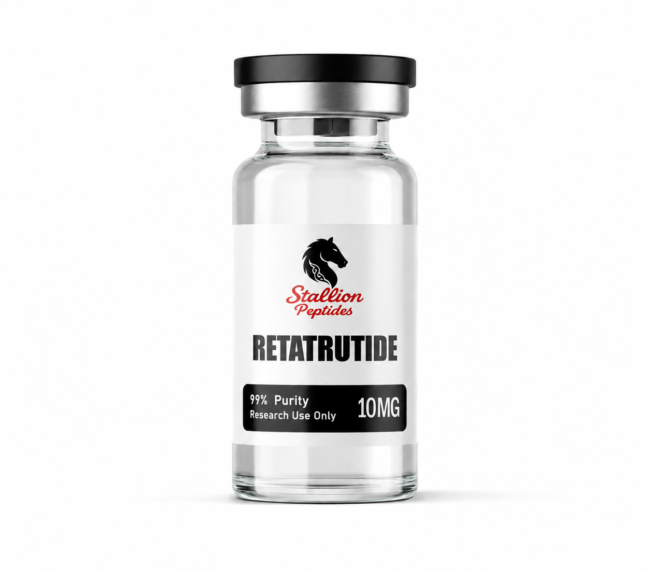
What is retatrutide?
Retatrutide (development code LY3437943) is a synthetic, lipidated peptide engineered to activate three class B G-protein-coupled receptors with a single molecule: the glucagon receptor (GCGR), the glucose-dependent insulinotropic polypeptide receptor (GIPR) and the glucagon-like peptide-1 receptor (GLP-1R).1
Like other long-acting incretin-class peptides, it carries a fatty-acid modification that promotes reversible albumin binding — a widely studied approach for extending the duration of action of peptide molecules.1
Receptor pharmacology in laboratory models
In the discovery work, retatrutide was characterised as a triple agonist with comparatively balanced activity at GCGR and GLP-1R and greater relative activity at GIPR.1 Adding glucagon-receptor agonism to the GIP/GLP-1 pairing is what distinguishes it from dual agonists such as tirzepatide.
Cryo-electron-microscopy structures of retatrutide bound to each of the three receptors have since been published, giving a molecular view of how one peptide engages three related receptors.2
Key point for researchers: retatrutide sits in the “multi-agonist” class — receptor selectivity and relative potency across GCGR, GIPR and GLP-1R are the central variables when comparing it with single or dual agonists.
Common research areas
- Multi-receptor agonism — how simultaneous GCGR/GIPR/GLP-1R activation compares with dual and selective agonists.1
- Structural biology — receptor–peptide binding modes resolved by cryo-EM.2
- Rodent metabolic models — comparative studies of energy expenditure and glucose handling in laboratory models.1
- Peptide engineering — lipidation, albumin binding and peptide stability.
Retatrutide vs tirzepatide (research comparison)
| Retatrutide | Tirzepatide | |
|---|---|---|
| Receptors | GCGR + GIPR + GLP-1R | GIPR + GLP-1R |
| Class | Triple agonist | Dual agonist |
| Code | LY3437943 | LY3298176 |
| Profile | This page | Tirzepatide profile |
Chemical & physical data
| Property | Value |
|---|---|
| Molecular formula | C₂₂₁H₃₄₂N₄₆O₆₈ |
| Molecular weight | ≈ 4731.3 g/mol |
| CAS number | 2381089-83-2 |
| Development code | LY3437943 |
| Supplied form | Lyophilized (freeze-dried) powder, sealed vial |
Storage & handling
Store lyophilized (powder) vials sealed, dry and away from light — at −20 °C for long-term storage. Once reconstituted, keep refrigerated at 2–8 °C. Allow vials to reach room temperature before opening to avoid condensation. Reconstitution is typically performed with sterile bacteriostatic water.