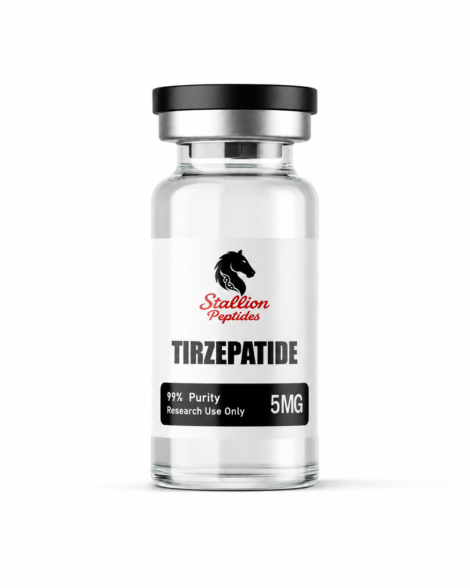
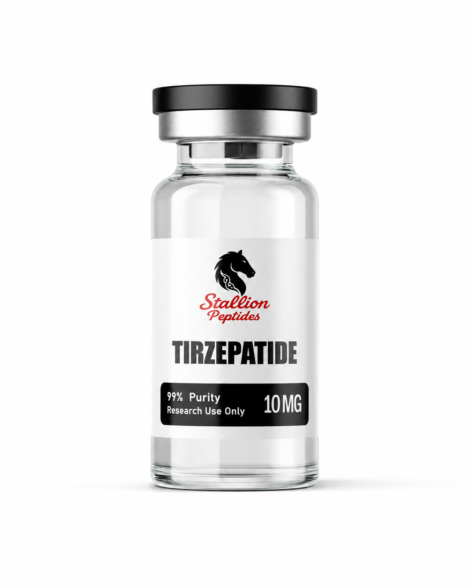
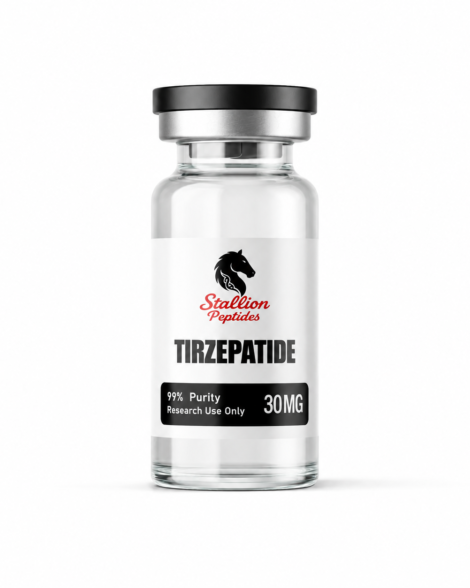
What is tirzepatide?
Tirzepatide (development code LY3298176) is a synthetic linear peptide of 39 amino acids designed to activate two incretin receptors: the glucose-dependent insulinotropic polypeptide receptor (GIPR) and the glucagon-like peptide-1 receptor (GLP-1R).1 Its sequence is based on the native GIP hormone, with substitutions that add GLP-1 receptor activity.
A C20 fatty diacid (eicosanedioic acid) is attached to a lysine side chain through a glutamic-acid and hydrophilic linker. This lipidation promotes reversible binding to serum albumin — a strategy widely studied for extending the duration of action of peptide molecules.1,3
Receptor pharmacology in laboratory models
In cell-based assays, tirzepatide binds GIPR with an affinity comparable to native GIP, while its affinity for GLP-1R is roughly five-fold lower than native GLP-1. Researchers describe it as an imbalanced dual agonist that favours GIPR.2
At the GLP-1 receptor, tirzepatide shows biased signalling: it preferentially stimulates cAMP production over β-arrestin recruitment, and in vitro this was associated with weaker receptor internalisation than native GLP-1.2 This biased-agonism profile is one of the most discussed topics in current incretin receptor research.
Key point for researchers: tirzepatide is not simply “two agonists in one molecule” — its unequal receptor potency and GLP-1R signalling bias are central variables when designing and interpreting assays.
Common research areas
- Incretin receptor signalling — cAMP vs β-arrestin pathways, receptor trafficking and desensitisation.2
- Comparative agonist studies — dual GIPR/GLP-1R agonism versus selective GLP-1R agonists in rodent metabolic models.1
- Peptide engineering — fatty-acid acylation, albumin binding and peptide stability.3
- Multi-agonist research — context for newer GIP/GLP-1/glucagon triple-agonist peptides such as retatrutide.
Chemical & physical data
| Property | Value |
|---|---|
| Molecular formula | C₂₂₅H₃₄₈N₄₈O₆₈ |
| Molecular weight | ≈ 4813.5 g/mol |
| Sequence length | 39 amino acids |
| Modification | C20 fatty diacid via γ-Glu–2×AEEA linker on Lys |
| CAS number | 2023788-19-2 |
| Supplied form | Lyophilized (freeze-dried) powder, sealed vial |
Storage & handling
Store lyophilized (powder) vials sealed, dry and away from light — at −20 °C for long-term storage. Once reconstituted, keep refrigerated at 2–8 °C. Allow vials to reach room temperature before opening to avoid condensation. Reconstitution is typically performed with sterile bacteriostatic water.