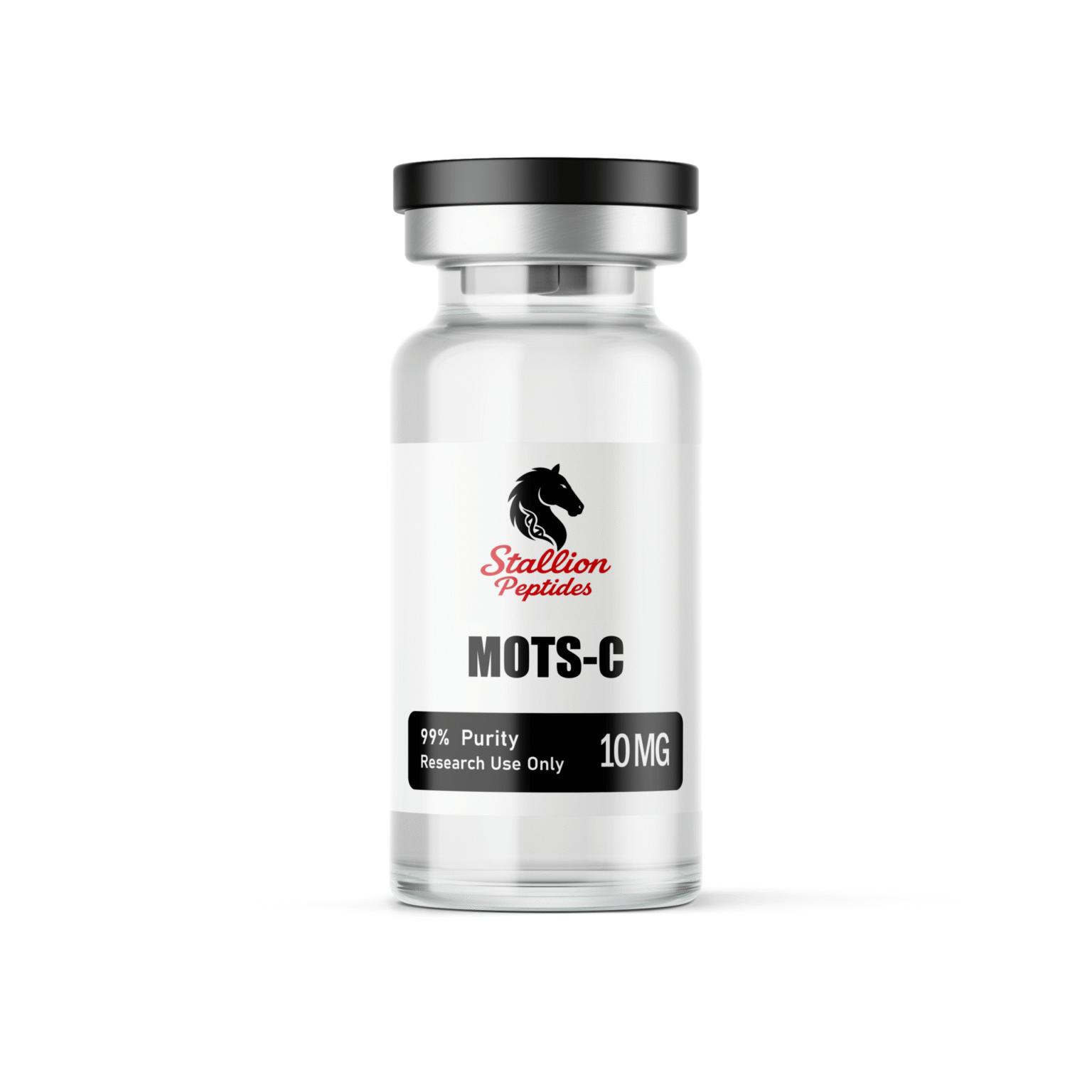
What is MOTS-c?
MOTS-c (mitochondrial open reading frame of the 12S rRNA type-c) is a 16-amino-acid peptide, MRWQEMGYIFYPRKLR, encoded within the mitochondrial gene for 12S ribosomal RNA. It was described in 2015 as one of a small family of mitochondrial-derived peptides — peptides encoded by mitochondrial rather than nuclear DNA.1
AMPK and mitochondria-to-nucleus signalling
In the discovery study, MOTS-c was reported to inhibit the folate–methionine cycle, leading to accumulation of the metabolite AICAR and activation of AMPK, a central sensor of cellular energy status, in cell and mouse models.1 A 2018 study reported that under metabolic stress MOTS-c moves into the nucleus, where it was associated with changes in nuclear gene expression — making it a model for retrograde (mitochondria-to-nucleus) signalling.2
Common research areas
- Energy sensing — AMPK activation and the folate–methionine cycle.1
- Retrograde signalling — nuclear translocation under metabolic stress.2
- Skeletal-muscle metabolism — glucose handling in rodent models.1
- Mitochondrial-derived peptides — comparisons with humanin and related peptides.
Chemical & physical data
| Property | Value |
|---|---|
| Sequence | MRWQEMGYIFYPRKLR |
| Length | 16 amino acids |
| Molecular formula | C₁₀₁H₁₅₂N₂₈O₂₂S₂ |
| Molecular weight | ≈ 2174.6 g/mol |
| CAS number | 1627580-64-6 |
| Origin | Mitochondrial 12S rRNA gene |
| Supplied form | Lyophilized (freeze-dried) powder, sealed vial |
Storage & handling
Store lyophilized (powder) vials sealed, dry and away from light — at −20 °C for long-term storage. Once reconstituted, keep refrigerated at 2–8 °C. Allow vials to reach room temperature before opening to avoid condensation. Reconstitution is typically performed with sterile bacteriostatic water; see our storage & handling guide.