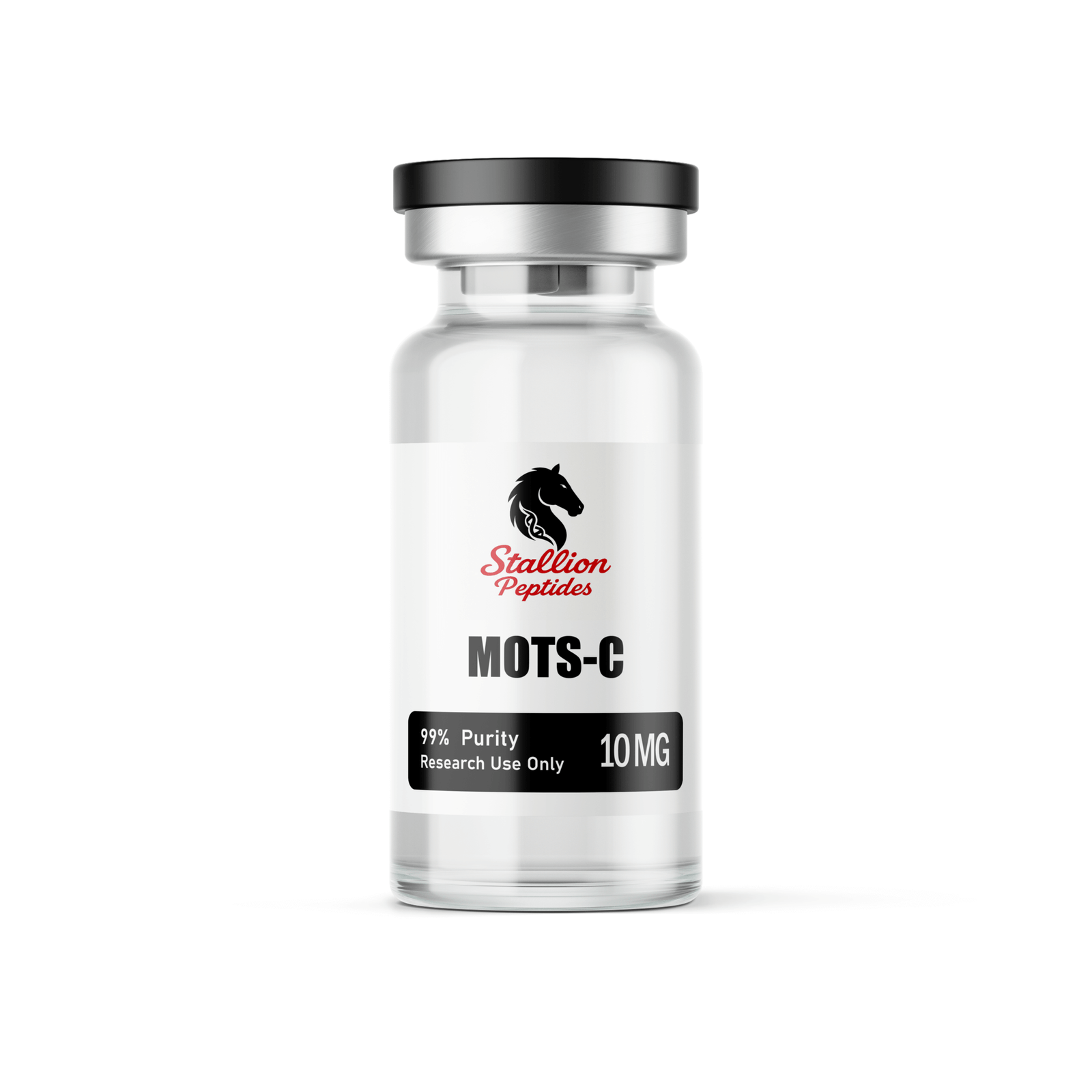
MOTS-c 10MG
Mitochondrial-derived. Endlessly studied.
$31.49
Buy 3+ vials, save 5% · 5+ vials, save 10%. Applied automatically.
MOTS-C 10MG is a research peptide studied for its involvement in cellular metabolism, mitochondrial function, and molecular signaling pathways. Researchers investigate its biological activity and peptide interactions in controlled laboratory environments. This product is supplied strictly for scientific and educational research purposes only.
Secure checkout · We accept
Description
MOTS-c 10MG at a glance
MOTS-c is a 16-amino-acid mitochondrial-derived peptide. Unusually, it is encoded not in the nuclear genome but in mitochondrial DNA — within the gene for the 12S ribosomal RNA. Since it was described in 2015, it has become a reference compound for research into how mitochondria signal to the rest of the cell. Each vial contains 10 mg of lyophilized peptide.
Specifications
- Sequence: MRWQEMGYIFYPRKLR (16 amino acids)
- Molecular formula: C101H152N28O22S2
- Molecular weight: approx. 2174.6 g/mol
- CAS number: 1627580-64-6
- Origin: encoded in the mitochondrial 12S rRNA gene
- Form: lyophilized powder in a sealed vial · Quantity: 10 mg · Purity: 99%+
What researchers study
The 2015 discovery paper reported that MOTS-c acts in cell and mouse models through the folate–methionine cycle and AICAR accumulation, leading to activation of AMPK, a central regulator of cellular energy status. Later work reported that MOTS-c can move to the nucleus under metabolic stress.
- Mitochondria-to-nucleus (retrograde) signalling
- AMPK activation and cellular energy sensing
- Skeletal-muscle metabolism in rodent models
- Comparative work with other mitochondrial-derived peptides such as humanin
Storage & handling
Store the sealed vial dry and away from light at −20 °C for long-term storage; refrigerate at 2–8 °C once reconstituted. Let the vial reach room temperature before opening to avoid condensation. Sterile bacteriostatic water is the usual reconstitution diluent.
Frequently Asked Questions
What is a mitochondrial-derived peptide?
A peptide encoded by mitochondrial DNA rather than the nuclear genome. MOTS-c is encoded within the 12S rRNA gene.
Which pathway is MOTS-c most associated with?
AMPK activation, reported through the folate–methionine cycle and AICAR accumulation in the original 2015 study.
How long is MOTS-c?
16 amino acids: MRWQEMGYIFYPRKLR.
How fast does it ship?
Orders placed before 3 PM Pacific time (Monday–Saturday) ship the same day by USPS, arriving in 2–3 business days on the US mainland and 3–5 in Puerto Rico.
Background reading: MOTS-c research profile — mechanism, chemical data & references →
For research use only.
| Property | Details |
|---|---|
| CAS | 1627580-64-6 |
| PubChem CID | 146675088 |
| Molecular Formula | C101H152N28O22S2 |
| Molecular Weight | 2174.6 g/mol |
| Synonyms | Mitochondrial-derived peptide |