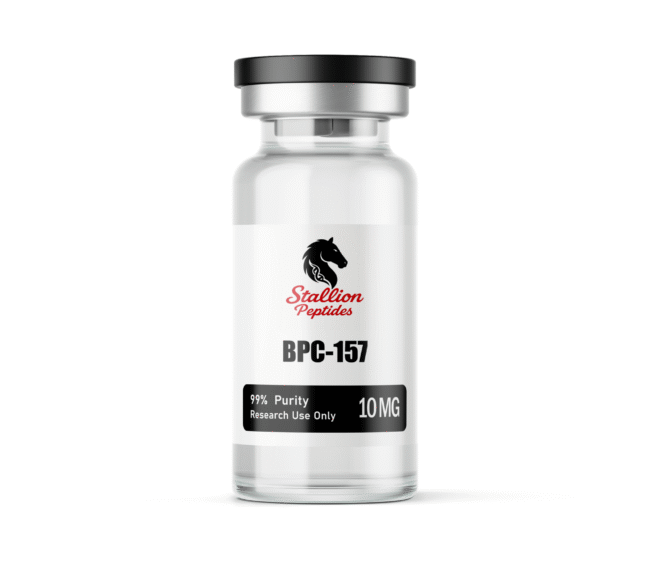
What is BPC-157?
BPC-157 is a synthetic pentadecapeptide — a chain of 15 amino acids with the sequence GEPPPGKPADDAGLV.4 “BPC” stands for Body Protection Compound: the sequence was taken from a larger protein first isolated from gastric juice, and BPC-157 is the short fragment that researchers synthesise and study.3
Unlike many research peptides, BPC-157 carries no fatty-acid chain or other chemical modification. It is a small, free peptide of about 1.4 kDa, and the literature frequently notes its stability in gastric juice — unusual for an unmodified peptide and one reason it is studied by several routes in animal models.3
Signalling pathways studied in laboratory models
VEGFR2 and angiogenesis
In endothelial cell culture, BPC-157 was reported to increase the expression and internalisation of the VEGF receptor 2 (VEGFR2) and to activate the VEGFR2–Akt–eNOS pathway, with increased endothelial tube formation. The same study used the chick chorioallantoic membrane (CAM) assay and a rat hind-limb ischemia model.1
Cell migration and the FAK–paxillin pathway
In cultured tendon fibroblasts, BPC-157 was studied for its effect on cell outgrowth, survival and migration, with activation of the FAK–paxillin pathway reported as part of the mechanism.2
The nitric oxide system
Review articles describe a large body of rodent work examining interactions between BPC-157 and the nitric oxide (NO) system, alongside other growth-factor signalling.3
Key point for researchers: most published BPC-157 data come from cell culture and rodent models, and a large share from a small number of research groups. Independent replication and carefully controlled designs are worth building into any new study.
Common research areas
- Angiogenesis signalling — VEGFR2 expression, Akt–eNOS activation and endothelial tube-formation assays.1
- Cell migration — fibroblast outgrowth and FAK–paxillin signalling in vitro.2
- Peptide stability — behaviour of an unmodified short peptide in gastric and other biological fluids.3
- Comparative designs — side-by-side work with TB-500, which is studied through a different mechanism (actin binding).
Chemical & physical data
| Property | Value |
|---|---|
| Sequence | GEPPPGKPADDAGLV |
| Length | 15 amino acids |
| Molecular formula | C₆₂H₉₈N₁₆O₂₂ |
| Molecular weight | ≈ 1419.5 g/mol |
| CAS number | 137525-51-0 |
| Supplied form | Lyophilized (freeze-dried) powder, sealed vial |
Storage & handling
Store lyophilized (powder) vials sealed, dry and away from light — at −20 °C for long-term storage. Once reconstituted, keep refrigerated at 2–8 °C. Allow vials to reach room temperature before opening to avoid condensation. Reconstitution is typically performed with sterile bacteriostatic water; see our storage & handling guide.