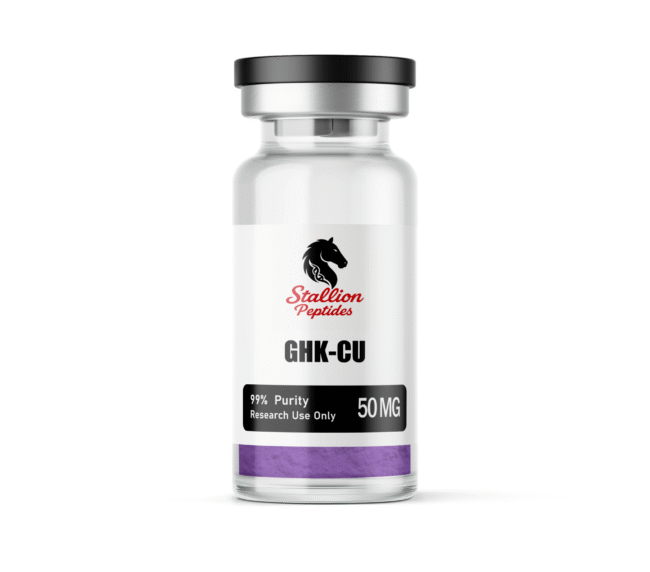
What is GHK-Cu?
GHK is a naturally occurring tripeptide — glycyl-L-histidyl-L-lysine — with a high affinity for copper(II) ions. Its copper complex is known as GHK-Cu. The peptide was first isolated from human plasma in 1973 and has since been detected in plasma, saliva and urine.12
Because of its small size and strong copper binding, GHK-Cu is widely used as a model compound for studying copper transport and copper-dependent processes in cells.1
What the laboratory literature reports
A 2018 review in the International Journal of Molecular Sciences summarises decades of laboratory work on GHK-Cu, including studies of extracellular-matrix components such as collagen and glycosaminoglycans in fibroblast cultures, antioxidant activity, and tissue-remodelling models.1
The same review highlights gene-expression analyses suggesting that GHK can influence the expression of a large number of human genes in cell-based datasets — one of the main reasons the peptide remains an active research subject.1
Key point for researchers: GHK-Cu is studied both as a copper-delivery complex and as a signalling peptide — keeping the free peptide (GHK) and its copper complex distinct is important when designing and interpreting experiments.
Common research areas
- Extracellular matrix — collagen and glycosaminoglycan synthesis in fibroblast cultures.1
- Gene-expression studies — large-scale transcriptomic datasets.1
- Copper biology — copper transport and copper-dependent enzymes.1
- Oxidative-stress models — antioxidant activity in laboratory systems.1
Chemical & physical data
| Property | Value |
|---|---|
| Sequence | Gly-His-Lys (GHK) |
| Formula (free peptide) | C₁₄H₂₄N₆O₄ |
| Formula (copper complex) | C₁₄H₂₂CuN₆O₄ |
| Molar mass (free peptide) | ≈ 340.4 g/mol |
| CAS (GHK / GHK-Cu) | 49557-75-7 / 89030-95-5 |
| Supplied form | Lyophilized powder, sealed vial |
Storage & handling
Store lyophilized (powder) vials sealed, dry and away from light — at −20 °C for long-term storage. Once reconstituted, keep refrigerated at 2–8 °C. Allow vials to reach room temperature before opening to avoid condensation. Reconstitution is typically performed with sterile bacteriostatic water. New to these terms? See the peptide research glossary.